|
Google Slides to the Full Slideshow (PDF below): https://docs.google.com/presentation/d/1F-U62vtkuFpnW1Rj1bdCqeu2F3fOpG-0/edit?usp=sharing&ouid=106061852616377032986&rtpof=true&sd=true In the rapidly evolving landscape of education, the integration of Artificial Intelligence (AI) has emerged as a transformative force, offering a myriad of possibilities to enhance teaching and learning. As a professor deeply immersed in the realms of educational technology and secondary education, it is my pleasure to distill the essence of our extensive exploration into AI's impact on education, from its definitional nuances to its ethical considerations. The heart of our journey forward lies in understanding the potential of AI in education. We must delve into the intricate ways AI fosters personalized learning experiences, adapts to individual needs, and revolutionizes the traditional paradigms of education. From intelligent tutoring systems to the power of augmented and virtual reality, AI is ushering in an era where education is no longer a one-size-fits-all endeavor but a dynamic, tailored experience for each student. Yet, this transformative journey is not without its ethical considerations. As stewards of education, we bear the responsibility of addressing privacy concerns, mitigating biases, and championing fairness in AI algorithms. Our exploration into the ethical dimensions of AI underscores the imperative for educators and institutions to navigate the AI landscape with a keen eye on responsible and ethical practices. Looking ahead, we find ourselves on the cusp of a new educational frontier. The future of AI in education promises an array of emerging technologies, from AI-driven curriculum design to the assessment of non-cognitive skills. Our predictions and possibilities sketch a landscape where education is not confined by traditional boundaries but opens up avenues for lifelong learning, global collaboration, and enhanced accessibility. As we stand on the brink of this transformative future, it becomes paramount for educators and institutions to prepare for the next wave of educational technology. Professional development, data privacy measures, and ethical guidelines will form the cornerstone of navigating this new era, ensuring that we harness the power of AI responsibly for both ourselves and our students. Investment in infrastructure, adherence to ethical frameworks, and a commitment to ongoing research and evaluation will guide us toward a future where AI in education is a force for positive change. In essence, the key takeaways from our exploration converge on the imperative of embracing the AI revolution in education. The potential is vast, the ethical considerations are nuanced, and the future is bright. Let us, as educators, not only witness but actively participate in shaping this transformative journey toward a more dynamic, equitable, and technologically empowered educational landscape. Thank you! 
0 Comments
I have a new Vlog that is now live! You can check it out at bit.ly/PLProfessor.
Episodes 1 and 2 are now available, and below are the resources used in Episode 2 (in order of appearance). Shemshack, A., & Spector, J. M. (2020). A systematic literature review of personalized learning terms. Smart Learning Environments, 7(1), 1-20. https://doi.org/10.1186/s40561-020-00140-9 U.S. Department of Education (2010). Transforming American education: Learning powered by technology. Office of Educational Technology, Washington, D.C. Retrieved from http://www.ed.gov/sites/default/files/netp2010.pdf U.S. Department of Education (2017, January). Reimagining the role of technology in education: 2017 national education technology plan update. Office of Educational Technology, Washington, D.C. Patrick, S., Kennedy, K., & Powell, A. (2013). Mean What You Say: Defining and Integrating Personalized, Blended and Competency Education. International Association for K-12 Online Learning. Bill & Melinda Gates Foundation, Afton Partners, Eli & Edythe Broad Foundation, CEE Trust, Christensen Institute, Charter School Growth Fund, EDUCAUSE, iNACOL, The Learning Accelerator, Michael & Susan Dell Foundation, Silicon Schools (2014). A working definition of personalized learning. Retrieved March 3, 2021, from https://assets.documentcloud.org/documents/1311874/personalized-learning-working-definition-fall2014.pdf National Center for Learning Disabilities (2015). Personalized learning: Policy & practice recommendations for meeting the needs of students with disabilities. Retrieved from https://www.ncld.org/wp-content/uploads/2017/11/Personalized-Learning-Recos.Final_.110917-4.pdf Gross, B., & DeArmond, M. (2018). Personalized Learning at a Crossroads: Early Lessons from the Next Generation Systems Initiative and the Regional Funds for Breakthrough Schools Initiative. Center on Reinventing Public Education. Fisher, J. F. (2019, Jan. 15). Defining personalized learning and blended learning: Is there a difference? Clayton Christensen Institute. Retrieved from https://www.christenseninstitute.org/blog/defining-personalized-learning-and-blended-learning-is-there-a-difference/ Knowledge Works (2019). An introduction to personalized learning. Retrieved from https://knowledgeworks.org/wp-content/uploads/2019/05/introduction-personalized-learning-knowledgeworks-spf.pdf Graham, C. R., Borup, J., Short, C., & Archambault, L.Source (2019). K–12 blended teaching: A guide to personalized learning and online integration. EdTech Books. Retrieved from https://edtechbooks.org/k12blended Morin, A. (2021). Personalized learning: What you need to know. Understood. Retrieved from https://www.understood.org/en/school-learning/partnering-with-childs-school/instructional-strategies/personalized-learning-what-you-need-to-know LEAP Innovations (2021). The LEAP Learning Framework is the foundation for all of our work. Accessed on March 4, 2021. Retrieved from https://leapinnovations.org/leap-learning-framework/ Last semester in my Measurement Theory class, we were given a challenge to take everything we had learned - basically the process of creating a measurement tool including: defining constructs, conducting EFAs, conducting CFAs, different reasons and ways to do so, etc. - and condense it all down to a single page. Knowing that there was maybe too much information to condense it to a single type-written page, I got a bit creative and created a single page using PiktoChart and H5P. After sharing it with the class, they helped me get more information for the graphic so it could be a fairly complete summary of the semester. Unfortunately the H5P account has expired so the interactive map is unavailable, but the static image is posted below for reference. Most of the information for the graphic can be found here. The graphic is shared here for record keeping and for others to use as they see fit. 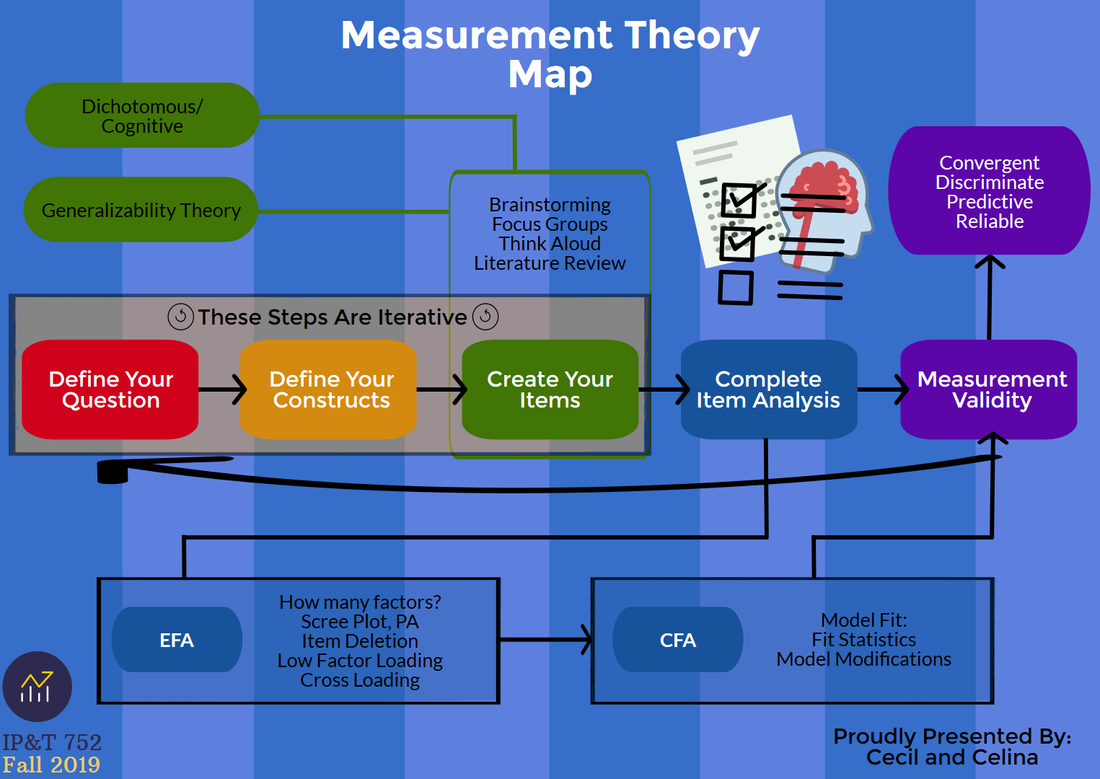
Back in October, I had the wonderful opportunity to attend the AECT conference in the beautiful Kansas City, Missouri. The conference started on Wednesday and went through the weekend, ending on Saturday, but I left for the conference early early because I wanted to see family, and because I attended a workshop on Tuesday. That workshop has inspired this post.
The workshop was offered by a graduate student from a university in the eastern United States, and focused on gamification of learning. It was really cool and I learned a lot; however, there was one thing that happened that I found troublesome. The workshop instructor asked the attendees of his workshop (there were three of us) a question that I have heard many times before in instructional design settings. The question was: Where do you stand on this spectrum of learning theories? He showed us a diagram that looked like this: 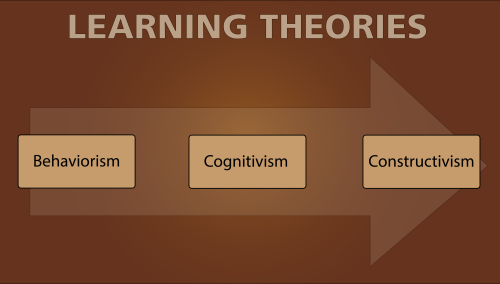
SIDEBAR: (Unfortunately, this is not an uncommon question at such conferences, and there have been times that the question has even led to heated debates between various groups of scholars. To be succinct, I think this debate is a dangerous waste of time for a field that has so much potential, and can accomplish so much more than deciding which approach to learning is best. Yet, I want to weigh in on the debate and explain why all sides are both simultaneously wrong, and right, about their stances. Let’s go back to my conference experience).
The workshop instructor began by stating his own stance on learning theories. He explained (in a weird kind of instructional design hipster fashion) that he used to be to the far right of the spectrum, even past Constructivism, but has since moved a little more to the left. Next he asked a friend of mine from Virginia Tech for her answer. She responded along the lines of, “Well, I have raised one husband, two dogs, and three kids, so I know Behaviorism works!” She went on to testify of the power of punishment and reward for furthering the learning of students, even pulling in some examples from learning through video games - which I appreciated. Next, the instructor asked one of my colleagues from BYU the same question. Being in the same program, her response did not much surprise me. She stated that she was somewhere between Cognitivism and Constructivism, and really kind of floats back and forth between them. In my opinion, this was by far the best response so far. HOWEVER, I could see from the look in the eyes of the instructor and my friend from Virginia Tech, that sides were already starting to form for the debate. The instructor turned to me and asked, “Cecil, how about you? Where do you fall?” The question made me feel as if I were being drafted for war, and my decision would tip the scales toward victory. I took a deep breath and said, “I think each of the learning theories you have on the board makes some dangerous assumptions about what is and is not considered learning, and that they all have too narrow of a view concerning the responsibilities of both learners and teachers. So, I consider myself to be a critical synthesizer.” 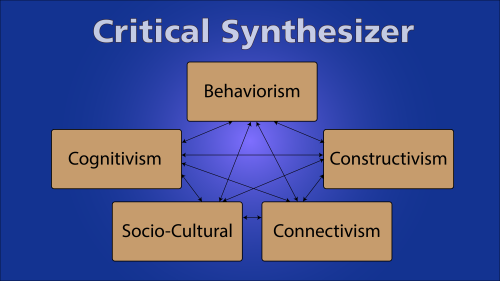
My friend from Virginia Tech responded instantly, “Ooh! I like that! Can I use it?” I told her that I’d be more than happy to let her use it, just give me credit.
The instructor asked me to clarify. What does it mean to be a critical synthesizer? Well, here goes:
Being a critical synthesizer is similar to what Yanchar and Gabbitas (2011) describe as practicing “critical flexibility.” They describe critical flexibility as the act of taking a “critical stance towards one’s own design sense and an awareness of alternative views that may facilitate the gradual development of one’s practice” (p. 388). Critical flexibility is important to the design and development of instruction, but works less well for guiding the act of instruction. By contrast, a critical synthesizer can change his or her approach to learning based upon the changing demands of a learning context. The critical synthesizer realizes, like the critically flexible designer, that various learning theories and movements have their uses, but using only one approach, or trying to use all of the approaches at once, creates binds in critical assumptions and/or practical applications for learning. The critical synthesizer moves from theory to theory and approach to approach based upon the demands of a learning context. Table 1 identifies some of the contexts and views of learning based upon some of the most popular theories and approaches. 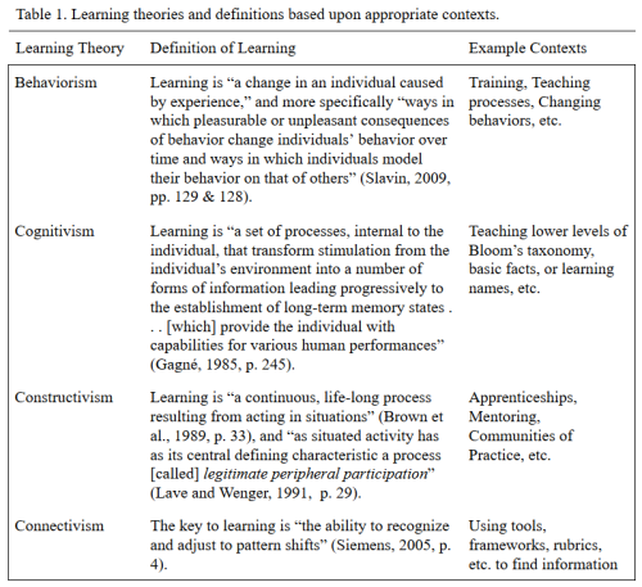
Given the ways in which learning in different contexts can overlap, it is important that educators take a broad approach to learning, understanding that it can have different implications under different circumstances. Learning how to act in elementary school, for example, is vastly different than learning to fly a plane. Taking the same approach to each learning scenario would not only be inappropriate, but foolish. If forced to provide a singular definition of learning, I would say I view learning as “a change in knowledge, understanding, or action that can occur under various circumstances and in various contexts.” Planning for various contexts requires educators to illustrate a critical understanding of the learning context, and a critical synthesis of learning theories and approaches.
I hope that as our field continues to mature, we will seek out less polarization of learning theories, and more compromise and understanding of the ways in which different learning theories can offer insight into different learning situations. Teaching and learning can be difficult concepts to understand, and both have a variety of explanations and approaches. But if educators and instructional designers are going to be prepared to overcome such difficulties they will need learn to become critical synthesizers who use the strengths of various approaches to meet the needs of their various learners in various situations. References Brown, J. S., Collins, A., & Duguid, P. (1989). Situated cognition and the culture of learning. Educational researcher, 18(1), 32-42. Gagné, R. M. (1985). A theory of instruction. The conditions of learning and theory of instruction (pp. 243-258). Fort Worth, Holt, Rinehart & Winston, Inc. Lave, J., & Wenger, E. (1991). Situated learning: Legitimate peripheral participation. New York: Cambridge University Press. Siemens, G. (2005). Connectivism: A learning theory for the digital age. International Journal of Instructional Technology and Distance Learning, 2(1). Slavin, R. E. (2009). Behavioral theories of learning. Educational psychology: Theory and practice (9th ed., pp. 126-155). Upper Saddle River, NJ: Pearson. Yanchar, S. C., & Gabbitas, B. W. (2011). Between eclecticism and orthodoxy in instructional design. Educational Technology Research and Development, 59, pp. 383-398. As I began thinking about this blog post, I was drawn to an article reporting that Dictionary.com has just announced their word of the year - “misinformation.” As I reflect on what I have experienced in the news, media, social networks, and personal conversations throughout 2018, I feel as if “misinformation” was a great choice. Dictionary.com defined their choice as different from another word that might have been fitting - “disinformation” - as follows. Misinformation - “false information that is spread, regardless of whether there is intent to mislead.” Disinformation - “deliberately misleading or biased information; manipulated narrative or facts; propaganda.” The difference between the two words is the intent of the one disseminating the information. Spreading false information unintentionally is called “misinformation,” while the intentional spread of false information is “disinformation.” But what does this have to do with OER? I’m glad you asked. As I have begun studying Open Educational Resources (OER) over the last year, I have come across many examples of misinformation. For example, at AECT this year I asked a fellow attendee how he felt about his first Breakfast of Champions. His response was, “Well … I learned that Open doesn’t have to be free.” This was misinformation. Despite the fact that many people can’t agree on a singular definition of “open” most can at least agree it means “free.” However, the use of the term “open” seems to have suffered from years of misinformation, as no one really seems to know what the word means when used as an adjective to describe some realm of OER outside of content. (And even then the use can be a bit hazy.) I recommend that those using the word “open” recognize Wiley’s Law when doing so. 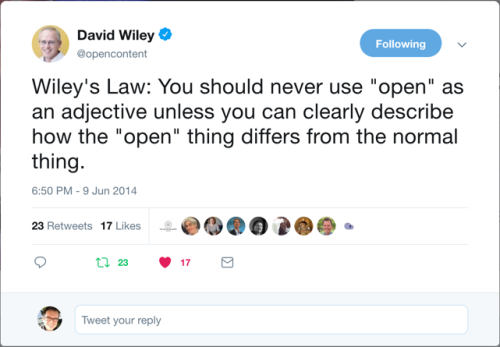 It is with this concept in mind that I present to you the OER Word of the Year for 2018 (and possibly the foreseeable future)! Ladies and Gentleman, I give you… 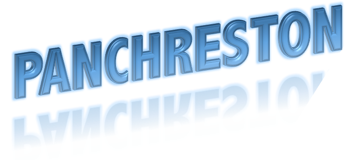 Merriam-Webster defines the word as “a broadly inclusive and often oversimplified thesis that is intended to cover all possible variations within an area of concern.” And Dicitonary.com defines the word as “a proposed explanation intended to address a complex problem by trying to account for all possible contingencies but typically proving to be too broadly conceived and therefore oversimplified to be of any practical use.” This is the current state of the word “open” as used in reference to many activities related to education. For example, “open-pedagogy” is term that dates back to the 1970s. This means that it pre-dates the “openness” that is afforded through the use of the internet, i.e., the openness that makes OER possible, the openness that helped spur the creation of Creative Commons licenses. The term “open-pedagogy” can mean:
(TL;DR too many dang things, “open pedagogy” is a panchreston) Did you know that by reading this blog post you are participating in some form of open pedagogy? 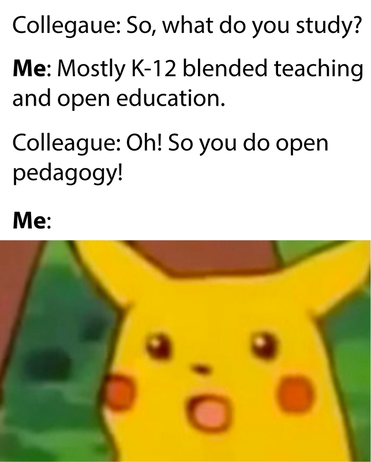 Because “open pedagogy” has become a panchreston, David Wiley has proposed a new term to use as part of the OER landscape that does not have the baggage of “open pedagogy.” That term is “OER-enabled pedagogy.” Wiley (2018) defines OER-enabled pedagogy as “the set of teaching and learning practices that are only possible or practical in the context of the 5R permissions which are characteristic of OER.” This means OER-enable pedagogy allows for the creation of assignments and instruction that can be:
This new term clarifies what pedagogy looks like in the world of OER. But, it has caused me to wonder what other OER-enabled practices would look like. In a previous post, I mused about the landscape of OER, and what it looks like in terms of what kind of OER currently exist. I used similar categories to define OER-enabled practices. The following graphic summarizes my thoughts concerning OER-enabled learning objectives, OER-enabled assessments, OER-enabled credentials, OER-enabled pedagogy, and OER-enabled content. 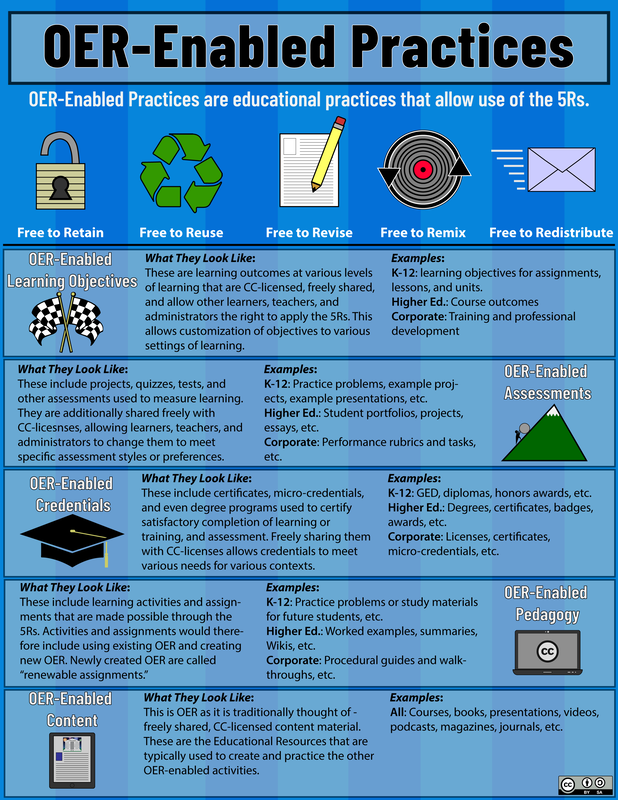 OER-Enabled Practices by Cecil R. Short is licensed under a Creative Commons Attribution-ShareAlike 4.0 International License. |
About
This blog presents thoughts that Cecil has concerning current projects, as well as musings that he wants to get out for future projects. For questions or comments on his posts, please go to his Contact page. Archives
September 2025
Tags
All
|
||
 RSS Feed
